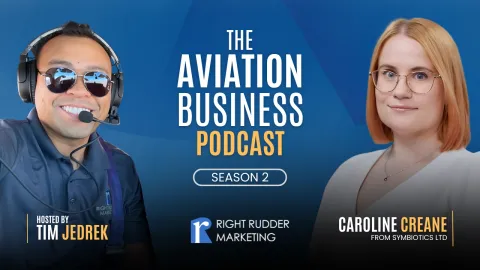
Caroline Creane is an aviation psychologist certified with the European Association of Aviation Psychology, with a background in occupational psychology and psychometric testing. She has spent 11 years at Symbiotics, a UK-based human performance company with around 30 years in aviation psychometrics and a team of just under 20 specialists. Her work sits at the point where flight schools stop guessing about who will finish training and start measuring it.
Professional Background
- Aviation Psychologist: Certified with the European Association of Aviation Psychology
- Occupational Psychology: Background in occupational psychology and psychometric test design
- 11 Years at Symbiotics: Helps develop the company’s psychometric tests and guides flight schools and airlines through implementing selection programs
- Global Reach: Supports a testing platform used in more than 80 countries across 130 or more locations
Symbiotics’ testing platform runs entirely online through a web link, requiring no local software and working for students anywhere in the world. Caroline is emphatic that it is not an aviation knowledge exam — it measures natural ability and underlying traits across three areas:
- Knowledge: Foundation areas such as math and physics that theory training builds on
- Aptitude: Psychomotor skills, processing speed, working memory, and capacity to handle a multitasking environment
- Personality and Behavior: Emotional stability, teamwork, motivation, and self-discipline
- Hazardous Attitudes: Screens for the same risk-taking tendencies the FAA emphasizes in decision-making training
- Aviation-Specific Norms: Scores are compared against an aviation population rather than the general public
- Fast Reporting: A report is generated within about five minutes, with matrix reports for full cohorts
Areas of Expertise
- Psychometric Assessment: Design and validation of tests that predict flight training success
- Pilot Selection: Combining cognitive ability with personality traits like conscientiousness and emotional stability
- Student Retention: Identifying where a student is likely to struggle before training begins
- Accreditation Standards: Prescreening requirements tied to the International Aerospace Accrediting Commission
- Test Integrity: Large question banks, remote invigilation, and emerging eye-tracking safeguards against AI-assisted cheating
Key Insights for Flight School Owners
- Prescreening is not a rejection tool: Schools decide how to use the report — as a development plan, an instructor-pairing guide, or an informed-consent debrief
- Washout rates are a business problem: Some Symbiotics clients have pushed washout below 5 percent, a 95 percent training success rate
- The hard conversation belongs at the start: Telling a student their real chance of success before a six-figure investment protects both the student and the school
- Accreditation is coming: The IAAC standard requires some form of prescreening, and accreditation is the path to Sallie Mae loan access
- The predictive profile is consistent: High conscientiousness, low neuroticism, and enough assertiveness to speak up in the cockpit